

Jump to a section
Balancing business ownership with motherhood isn’t simply a matter of time management; it’s a daily act of resilience. Across the UK, thousands of mothers are building businesses between school runs and nap schedules, all while navigating rising childcare fees, long waiting lists for nursery places, and gender pay gaps that limit earning potential from day one.
Many women turn to entrepreneurship in search of flexibility, financial security, or the freedom to build something of their own without sacrificing precious moments with their children. Yet the reality can feel very different.
To better understand where in the UK has the most and least supportive conditions for entrepreneurial mothers, Capital on Tap has analysed the 30 most populated cities, and ranked them based on metrics including childcare affordability and access, start-up activity, long-term business survival rates, gender pay inequality, and commuting pressures. The findings reveal the cities where mothers have the strongest foundation to build a business, and where the challenges are most acute.
To bring the findings to life and explore what it really means to build a business while raising a family, we spoke with Lisa, a mother and co-founder of The Biskery. Lisa shared her experience of growing a company alongside childcare demands, from budgeting around nursery fees to navigating time pressures that shape every decision.
Expert commentary from Rebecca Alford, CFO at Capital on Tap, rounds off the insight, offering practical strategies for mothers balancing business growth with family life. From managing cash flow to building financial resilience and using business tools that free up time, their guidance empowers entrepreneurial mothers to scale sustainably without sacrificing the moments that matter most.
The best UK cities for entrepreneurial mothers
To determine the most supportive locations for business-owning mothers, we analysed key indicators including childcare availability, childcare costs relative to average female earnings, start-up activity, business survival rates, commuting demands, and the local gender pay gap.
|
Rank |
Location |
Number of start ups per 10,000 |
Business survival rates 5 years |
Childcare as a % of earnings |
Childcare Accessibility (average places per 100 children) |
Avg Travel Time per 10km (minutes) |
Congestion % |
Median Gender Pay Gap (%) |
|
1 |
Newcastle upon Tyne |
309 |
42.7% |
40.1% |
24.6 |
15 |
20% |
12.2% |
|
2 |
Bournemouth |
868 |
40.5% |
73.3% |
25.8 |
19 |
32% |
13.9% |
|
3 |
Norwich |
382 |
40.5% |
45.0% |
23.8 |
17 |
36% |
5.2% |
|
4 |
Leeds |
390 |
38.5% |
41.7% |
25.2 |
20 |
27% |
13.0% |
|
5 |
Bristol |
418 |
43.9% |
60.9% |
31.3 |
23 |
34% |
13.9% |
|
6 |
Stoke-on-Trent |
282 |
36.8% |
31.0% |
20.3 |
17 |
33% |
6.6% |
|
7 |
Brighton & Hove |
572 |
31.0% |
53.7% |
34.3 |
20 |
35% |
19.2% |
|
8 |
Sheffield |
326 |
44.6% |
38.2% |
23.0 |
24 |
39% |
10.4% |
|
9 |
Portsmouth |
321 |
36.0% |
45.2% |
24.5 |
17 |
35% |
13.9% |
|
10 |
London |
652 |
38.6% |
56.7% |
28.0 |
33 |
32% |
10.8% |
1. Newcastle upon Tyne
Newcastle takes the top spot as the most supportive UK city for entrepreneurial mothers. While childcare costs £925 per month, it is 40.1% of the average female monthly wage, surprisingly one of the lowest of the cities studied highlighting the expensive childcare costs parents are facing. It’s also important to take into account the gender pay gap, which sits at 12.2%, meaning women are earning over 10% less than their male counterparts. The city also has great nursery availability (24.6 places per 100 children), which means mothers are more likely to secure consistent childcare, something that too often becomes a gatekeeper to business growth.
Where the city excels is in how long businesses survive. With a 42.7% five-year survival rate, slightly above the UK average of 38.4%, new ventures here have a stronger chance of lasting, crucial for mothers who may grow more gradually due to family responsibilities. And with shorter travel times (15 minutes per 10km) and relatively low congestion (20%), less time is lost navigating the school run or commuting to clients.
The demands of business and motherhood don’t disappear in Newcastle, but they’re not made harder by the city around you. Instead, the environment is supportive enough that, for many mothers, turning an idea into something real becomes possible.
2. Bournemouth
Bournemouth ranks second, with 868 start-ups per 10,000 residents, making it one of the most active entrepreneurial scenes out of the cities we studied. Businesses here have a strong 40.5% five-year survival rate, meaning ventures are more likely to stay the course. For entrepreneurial mothers looking to collaborate, find clients locally or grow through strong networks, Bournemouth offers an environment where they don’t have to build a business alone.
Even day-to-day travel plays a role in how much time mothers can dedicate to their business. With journeys averaging 19 minutes per 10km and 32% congestion rate, Bournemouth offers a relatively manageable commute compared to larger cities.
Childcare, however, doesn’t come cheap. The costs average £1,700 per month, one of the highest figures in our ranking, meaning the average woman must spend 73.3% of her earnings on it. While availability is relatively strong (25.8 places per 100 children), the price of securing those hours can make it harder for mothers to reinvest in their business, even when the support is there to help them work.
3. Norwich
Rounding off the top three is Norwich. With a 40.5% five-year survival rate, the city gives new ventures the breathing room they need to grow at a steady pace, something especially valuable for founders juggling childcare schedules and limited working hours.
Childcare costs here are more manageable than in many cities (£1,025 per month, 45% of earnings), even if places are still competitive (23.8 per 100 children).
What really sets Norwich apart is pay equity. With a gender pay gap of 5.2%, one of the lowest in our ranking, women are less likely to start their entrepreneurial journey on the back foot. For many mothers, that means entering business with a little more financial security and confidence to invest in their ideas.
The most challenging UK cities for entrepreneurial mothers
While some cities offer strong foundations for entrepreneurial mothers, others still lack the support systems needed for owning a business and being a parent to coexist sustainably.
|
Rank |
Location |
Number of start ups per 10,000 |
Business survival rates 5 years |
Childcare as a % of earnings |
Childcare Accessibility (average places per 100 children) |
Avg Travel Time per 10km (minutes) |
Congestion % |
Median Gender Pay Gap (%) |
|
1 |
Liverpool |
329 |
29.4% |
52.3% |
22.9 |
25 |
35% |
17.5% |
|
2 |
Birmingham |
367 |
25.0% |
51.6% |
21.3 |
21 |
38% |
8.9% |
|
3 |
Kingston upon Hull |
278 |
41.8% |
51.6% |
16.3 |
22 |
46% |
9.6% |
|
4 |
Plymouth |
264 |
43.9% |
93.0% |
23.0 |
19 |
31% |
16.1% |
|
5 |
Manchester |
414 |
28.9% |
62.2% |
22.5 |
25 |
32% |
2.9% |
|
6 |
Nottingham |
316 |
33.7% |
63.7% |
24.3 |
24 |
35% |
3.0% |
|
7 |
Southampton |
334 |
33.1% |
50.4% |
27.1 |
21 |
38% |
13.0% |
|
8 |
Reading |
402 |
38.8% |
47.5% |
30.5 |
21 |
37% |
31.6% |
|
9 |
Coventry |
320 |
36.4% |
41.8% |
18.5 |
21 |
33% |
10.8% |
|
10 |
Leicester |
375 |
38.7% |
36.0% |
19.7 |
25 |
39% |
8.2% |
1. Liverpool
Childcare costs average £1,200 per month, meaning the average female is spending over half their pay packet (52.3%) on additional support. Availability is also more limited, with 22.9 places per 100 children, placing Liverpool towards the lower end of our rankings for access.
Business longevity also dips when compared with more supportive cities. Just 29.4% of businesses remain open after five years, a noticeably smaller share than places like Newcastle, Sheffield or Bristol, where a slower growth pace is easier to sustain.
Liverpool still offers opportunity and a strong entrepreneurial community, but compared with other cities in our index, the combined pressures of childcare access and business stability mean mothers have to work a little harder to keep routine and business growth aligned.
2. Birmingham
Birmingham takes second place. It’s one of the UK’s most active business hubs, but only 25% of start-ups make it past the five year anniversary.
Childcare fees align with those in other large cities (£1,187.90 per month and 51.6% of the average female monthly salary), but there is less availability (21.3 per 100 children). It’s not just cost that matters, it’s whether hours are free when you need them. The city’s transport network adds another layer: while congestion levels (38%) are fairly typical for a large urban area, 20-minute journeys for every 10km travelled make short working windows harder to use efficiently.
One advantage is that Birmingham’s gender pay gap is smaller (8.9%) than in many cities, meaning mothers aren’t starting from as big a financial disadvantage. Even so, the combination of limited time and slower business progression means building a company here demands patience.
3. Kingston upon Hull
Kingston upon Hull rounds out our top three. Childcare expenditure matches Birmingham at 51.6% of the average female monthly salary, at £1,052 per month, and businesses are more likely to last long term (41.8% survive five years), which makes the city promising once a business is established.
The difficulty lies before that stage. Hull has the lowest childcare availability in our index (16.3 places per 100 children). Even when parents can afford childcare, the lack of spaces means they can’t always secure it when they need it. For mothers launching a business, this impacts the very first step: having regular time to produce work, meet clients, or plan growth.
Rebecca Alford at Capital on Tap, comments: “Entrepreneurial mothers often face challenges before their business journey even begins. Childcare that is costly or hard to secure, longer or inflexible commutes, and pay gaps that reduce financial security can all limit the time and confidence needed to start a business.
“When cities improve access to childcare, support fairer earnings and make it easier for parents to balance work and family life, it doesn’t just help individual mothers; it strengthens local business growth. With the right support in place, more women are able to turn ideas into sustainable businesses that benefit their communities.
“Helping mothers build companies isn’t just about reducing pressure day to day. It’s about creating the conditions where their talent, ambition and skills have the space to thrive.”
How a Leeds-based founder built a six-figure biscuit business around motherhood
While many mothers turn to self-employment to gain flexibility, few manage to scale a six-figure business while working part-time.
We spoke to Lisa de Boer, co-founder of The Biskery, to explore how she and her business partner, Saskia Roskam, transformed personalised biscuits into a powerful message of belonging, building a company shaped by women, for women.

Starting with kindness as the mission
What started as two ex-marketers missing the flavours of home has grown into a thriving online gifting company producing branded biscuit gifts for special occasions, celebrations, and corporate events. Today, 80% of The Biskery’s orders come from the B2B market, including logo biscuits for global brands.
For Lisa, the business was never just about baking. The Biskery exists to make people feel seen, valued and appreciated through personalised treats. She explains: “Our vision is to reach 10 million people with gestures of kindness.”
That mission is now baked into every decision the company makes, from custom biscuits to how it treats the women who work there.
Turning frustration into opportunity
Motherhood didn’t just influence Lisa’s business journey, it changed it entirely. After returning from maternity leave at a digital marketing agency, she found herself stripped of her senior role and removed from client work because she worked part-time.
Lisa says: “I channelled my anger into passion for my own business, where I would do things differently.”
That moment pushed her to build a business where mothers never have to choose between being valued and being present.
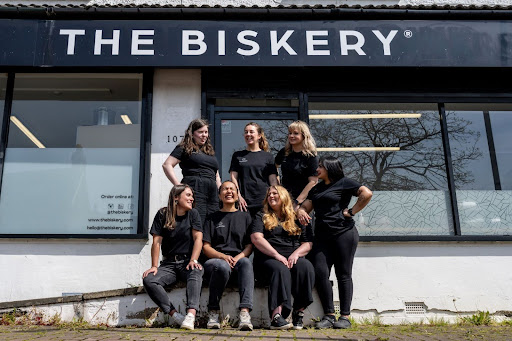
The Biskery now employs seven women, most of them mothers, all working flexibly or part-time. Lisa picks up her children from school every day at 3:20 pm, and her team work to their own childcare rhythms rather than a rigid schedule.
Building a business at a slower, sustainable pace
Like many business-owning mothers, Lisa has had to navigate the realities revealed in our Index: unpredictable childcare, limited time, and slow growth by necessity. Networking events often occur at times when parents can’t commit, such as early mornings or after work, meaning opportunities have to be turned down.
Lisa adds: “We’ve grown more slowly than others because we simply can’t give it as much time as we would if we were childless. It’s a sacrifice.” But instead of seeing slower growth as a setback, Lisa sees it as a strategic reality, one that preserves energy and protects families.
Rather than trying to work as if motherhood hadn’t changed her life, Lisa reshaped her business to fit the reality of parenting. School pickups, sick days, and holidays aren’t obstacles, they’re the framework The Biskery is built around. She and her team create clear systems so the business never relies on one person being available full-time. If a child is ill or childcare falls through, someone else can step in. Lisa says: “We built the business so it doesn’t need one person to be here 40 hours a week.”
Growth is slower by design, but intentional. For Lisa, success isn’t scaling as fast as possible; it’s building a profitable business that doesn’t cost her the years she wants to spend with her children: “People think the goal is to grow fast. For us, growth that still lets us enjoy our children is the real success.”
Starting a business in Leeds
Leeds, also ranking fourth in our Index as the best cities for entrepreneurial mothers, has played a positive role in The Biskery’s journey. A strong start-up ecosystem and supportive community have helped Lisa thrive without uprooting her life for a London-centric business scene. Lisa says: “We proudly wave the flag for Yorkshire. Leeds is a very supportive place to be a working mother.”
Still, she believes more can be done nationally, especially around access to childcare, which remains expensive and often requires parents to secure places months in advance.
Lisa says: “Free childcare would change everything. Affordable co-working spaces with nurseries attached would mean women could work, build businesses and have their children close. That’s the future I want to see.”
Lisa concludes with a final message for mothers thinking about starting a business: “Do it, the world needs you. But manage your energy and expectations. You can do it, but you can’t do it all at once.”
Capital on Tap shares practical guidance for mothers starting a business
Starting a business while raising children requires more than entrepreneurial drive; it demands careful financial planning, time-efficient decision-making, and the confidence to build something that works alongside family life, not against it.
Rebecca at Capital on Tap shares practical strategies to help mothers build resilient businesses that grow sustainably without sacrificing family priorities. “Mothers aren’t just building businesses, they’re building them within tight windows of time and often with less financial cushioning to fall back on. A business doesn’t need 40 hours a week to succeed, but it does need clarity, smart money decisions, and support. With the right tools and planning, mothers can create companies that grow at a pace that protects both their families and their ambitions.”
1. Build a business model that fits your available time
Rather than worrying about how many hours you can’t work, focus on what you can deliver consistently within the time you have. Choose products or services that don’t require constant availability and create systems that work even when you’re not online.
2. Separate home and business finances from day one
When every pound counts, mixing personal and business spending creates confusion and stress. Use a dedicated business credit card and account to track expenses, understand profitability quickly, and make informed decisions about reinvestment, even on a small scale.
3. Use business tools that buy back time
Automating administration, from invoicing to inventory management, can save hours each month. Tools like accounting software, payment platforms, and digital scheduling systems reduce mental load and help mothers focus on work that creates revenue rather than admin.
4. Use rewards and finance tools strategically
Business credit card rewards and cashback programmes can help spread early costs and reinvest earnings into growth without harming cash flow. Used responsibly, these tools can support scaling through equipment purchases, marketing, or new stock. Small financial boosts compound over time when growth is steady.
5. Build a support network beyond childcare
Support doesn’t just mean help at home, it means community in business. Seek out other founders, join local networks, and connect with mentors who understand the realities of juggling parenting and entrepreneurship. The right network saves time, opens doors, and shares solutions you don’t have to figure out alone.
6. Grow at a pace that protects your well-being
Many mothers build slower, not because they’re less ambitious, but because they’re building sustainability into their business. Revenue that grows steadily and doesn’t compromise family life is often more profitable long term.
Rebecca concludes: “Success doesn’t have to be fast to be meaningful. With smart financial choices, realistic planning, and access to supportive tools, mothers can build businesses that fit the lives they want to lead, not the other way around.”
Sources and methodology
To reveal the best and most challenging UK cities for entrepreneurial mothers, 30 locations were ranked using seven core indicators that affect business growth, time availability and financial stability. These include:
-
Number of business start-ups: ONS Business Demography
-
Start-ups per capita: ONS Business Demography cross-referenced with UK city population data
Five-year business survival rate: ONS Business Demography -
Average childcare costs: Numbeo
-
Childcare as a % of earnings: Average female salaries taken from ONS Earnings data. This is calculated using the average childcare costs.
-
Childcare accessibility (places per 100 children): ONS Childcare Accessibility by Neighbourhood
Average travel time per 10km and congestion levels: TomTom Traffic Index -
Median gender pay gap (%): ONS Gender Pay Gap 2024
-
Childcare access calculation: ONS childcare data is published at the neighbourhood (LSOA) level. To calculate city-level averages, neighbourhoods were grouped by Local Authority using the ONS “LSOA to Local Authority Best Fit Lookup”.
Ranking methodology: Each metric was scored numerically, and cities were ranked based on affordability, childcare accessibility, business sustainability, commuting pressures and pay equity. Higher scores were awarded to cities offering stronger foundations for mothers balancing business and family life.
Date of data collection: November 2025